



Working Principle and Core Value of OTC Daihen Robot Dedicated Positioner System
In the system integration of automated arc welding workstations, when dealing with workpieces featuring complex structures, staggered weld seams, large circular seams, or multi-faceted box structures, relying solely on the welding robot’s own six joint axes is often insufficient to perfectly reach all welding dead corners. The core function of the OTC DAIHEN Robot Dedicated Welding Positioner (serving as the seventh and eighth external axis systems directly under closed-loop control by the control cabinet) is to firmly clamp complex workpieces and drive them to rotate and tilt, thereby presenting the most favorable process posture for welding.
Once the positioner completes external axis cascading with the robot control cabinet via a digital bus, it can achieve extremely advanced full-synergy synchronous interpolation between two machines (commonly known as “welding while rotating”). During welding, the rotation of the positioner remains in perfect linear speed synchronization with the flexible wrist flipping of the robotic arm, ensuring that the weld pool, under the influence of gravity, always stays in the optimal “Downhand Position”. This not only significantly eliminates welding defects like undercut and lack of fusion but also produces high-quality weld seams with exceptionally uniform and beautiful surface ripples.
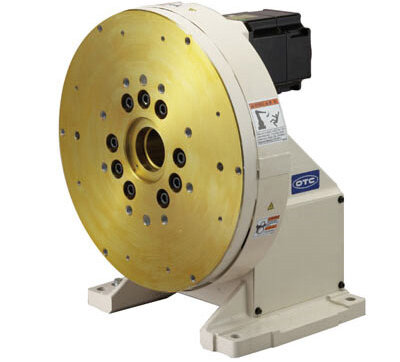
Figure 1: Appearance of OTC Daihen Industrial Single-Axis/Standard Axis Automated Welding Positioner
II. Structure and Reachability Advantages of Single-Axis and Dual-Axis Tilt Positioners (e.g., 1PF/2PF Series)
To cope with workpieces of different geometric curvatures, OTC positioners are mainly divided in hardware structure into the universal single-axis rotation series and the heavy-duty, highly flexible dual-axis tilt rotation series:
- Single-Axis Horizontal/Turnover Positioner: Suitable for longitudinal weld seams on regular shaft parts, outer circular seams on pipe wheels, or long box structures. Through single-axis 360° unlimited rotation, it drives the workpiece to flip to the perspective most suitable for the manipulator’s arc ignition.
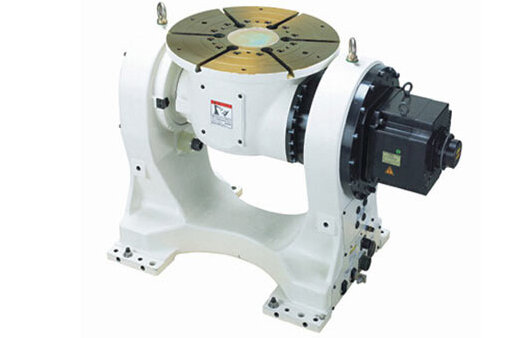
- Dual-Axis Tilt Positioner (360-Degree Rotation + 240-Degree Total Tilt): When the workpiece surface features multi-angle bevels, internal crossing holes, or irregular curved surfaces, the dual-axis positioner can exert an extremely high process advantage. Through built-in dual sets of high-power servo motors and high-rigidity RV reducers, it provides 360-degree unlimited clockwise/counterclockwise turntable rotation + 120-degree tilt in each lateral direction (totaling a 240-degree wide-angle main tilt). This additional tilting motion not only allows the workbench to tilt toward the operator side for fast and safe workpiece loading/unloading to reduce labor intensity, but also cooperates with the robot to complete highly difficult multi-coordinate complex trajectory welding in 3D space, greatly expanding the reachability of the welding torch.
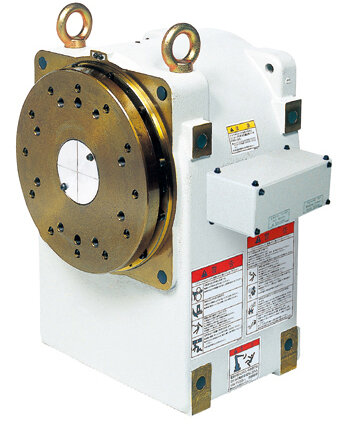
Figure 2: OTC Welding Robot and External Axis Positioner Executing Dual-Machine Full-Synergy Synchronous Interpolation (Welding While Rotating) Operations
III. Selection Configuration Parameter Comparison Table for Standard Series of OTC Welding Robot Positioners
The table below systematically outlines the configuration characteristics of single-axis and dual-axis positioners commonly used in mainstream industrial arc welding stations. This data table adopts a high-definition solid thin-line border design, rigorous grid arrangement, and clear zebra stripe contrast:
| Positioner Core Configuration Type | Controllable External Axes Quantity | Rotational Angle Range | Maximum Lateral Tilt Angle | Typical Applicable Workpieces and Automation Process Scenarios |
|---|---|---|---|---|
| Single-Axis Head-Tail/Rotary (e.g., 1PF Series Standard Type) |
1 External Axis (7th Axis) | 360° Unlimited CW/CCW Rotation | No Tilt Axis (Fixed Horizontal) | Suitable for standard regular components such as transmission shafts, axles, air tank outer circular seams, and pressure vessel longitudinal seams. |
| Single-Axis Horizontal L/R Turnover (Workstation Dual-Position Alternating) |
1 Main Axis (Multi-station Switching) | 180° / 360° Intermittent Positioning | No Tilt Axis | Suitable for small to medium parts like stainless steel mufflers and seat brackets, enabling welding on one side and manual loading/unloading on the other. |
| Dual-Axis Tilt/Rotary (e.g., 2PF Series Heavy-Duty Type) |
2 External Axes (7th, 8th Axes) | 360° Continuous Unlimited Rotation | 120° in Each Direction (Total 240° Tilt) |
Suitable for valve tees, complex multifaceted engineering machinery boxes, automotive subframes, and beveled curved weld seams. |
Figure 3: OTC Daihen Hardware-Level Dual-Axis Tilt Heavy-Load Welding Positioner Assembly
IV. What Core Advantages Can Integrating Original OTC External Axis Positioners Bring to the Workshop?
- 1. Massively Boost Overall Productivity: Automatically orienting and flipping workpieces replaces the cumbersome redundant time required in the past for frequent manual un-clamping, attitude adjustment via crane lifting, and re-locking, drastically shortening non-welding auxiliary time and exponentially speeding up workshop production rhythms.
- 2. Maintain Extremely Stable Welding Quality: The high-rigidity transmission structure of the positioner, combined with motor multi-turn absolute feedback, guarantees millisecond-level precise position and speed tracking. The weld seam is always formed in the optimal “downhand welding” posture, ensuring that the penetration depth and appearance ripple of each seam are highly consistent, thereby dramatically reducing the aesthetic rejection rate.
- 3. Significantly Reduce Labor Costs: Traditional complex structural parts required highly qualified veteran welders to perform highly difficult overhead or vertical welding operations, which involved high labor costs and extreme labor intensity. After deploying a dual-axis tilt positioner, all operations are converted into effortless flat welding or downhand welding, allowing general workers to quickly hoist workpieces, thereby sharply cutting labor expenses.
- 4. Perfect Seamless Integration with Control Cabinet System Cascading: Original external axis positioners are connected directly into the servo drive modules inside the control cabinet, sharing the same CPU calculation core and teach pendant programming commands. This prevents potential equipment hazards such as asynchronous movements between the robot and external axes, trajectory tearing, or arc ignition burn-back caused by communication interface delays of third-party non-standard positioners.
Core Specifications for External Axis Positioner System Integration and Workshop Frontline Preventive Heavy Maintenance:
- Strictly prohibit connecting unisolated strong power interlocks at the external axis rotary end: Pneumatic tooling, PLC position micro-switches, or sensors often need to be integrated on the positioner workbench. **It is strictly prohibited to connect their weak electrical signal lines directly to the control cabinet’s external wall sockets to drive heavy-load strong power equipment.** Physical isolation must be established via a primary standard passive isolated intermediate power relay (such as the originally designated
4341-305or 24V relay groups) to absolutely prevent accidental reverse crosstalk of arc welding high-voltage strong power, which could burn down the positioner encoder, external axis drive baseboard (L23455W00), and the expensive central CPU processing card inside the cabinet. - Hard limit on grease replacement life for external axis transmission box RV reducers: The positioner’s rotary turntable and main tilt arm frequently bear extremely heavy dynamic torque loads caused by the eccentricity of the workpiece and its tooling fixtures during continuous welding operations. The maintenance team must strictly execute the officially designated grease change hour specifications (working 10,000 hours or reaching periodic maintenance cycle), compulsorily pumping dry the old oil and filling in the originally designated VIGOGREASE RE0 or SK-2 special large-capacity long-life reducer main grease (e.g.,
5096-062516kg large barrel). Blindly mixing in cheap low-end automotive or common industrial yellow grease to save money is strictly prohibited; otherwise, it is highly prone to grease high-temperature shear failure and degradation, directly causing early severe spalling of the reducer gear surfaces and entirely scrapping the rotary repeat positioning accuracy of the system.
️ Get Robot External Axis Positioner Configuration Plans, Real-Time Quotes, and Authentic Consumable Spare Parts Technical Support
To match the most cost-effective single-axis/dual-axis positioner tonnage and specifications for your factory welding line, and to prevent blind integration that leads to servo motor overload, arm span failing to fully cover, or external axis bus data conflicts later on, you are welcome to contact us anytime. Please inform our technical directors of your workpiece material, steel plate thickness, maximum single-piece weight, and overall geometric dimensions. We will design high-uptime workstation overall configuration details and factory standard quotes for you free of charge in a short time. Meanwhile, our spot turnover center continuously supplies maintenance grease, control cabinet core communication boards, heavy-duty external axis power shielded harnesses, and original quick-change wear parts: