



OTC Daihen 7-Axis Welding Robot System Technical Innovation and Application Background
In modern industrial arc welding automation upgrades, although traditional 6-axis articulated robots can meet the welding needs of the vast majority of standard workpieces, when facing deep-cavity structures with intersecting internal pipe networks, complex tooling with dense fixtures, and extremely restricted narrow workshop aisles, 6-axis robotic arms are often unable to reach the ideal welding dead corners due to physical interference at the “elbow” section.
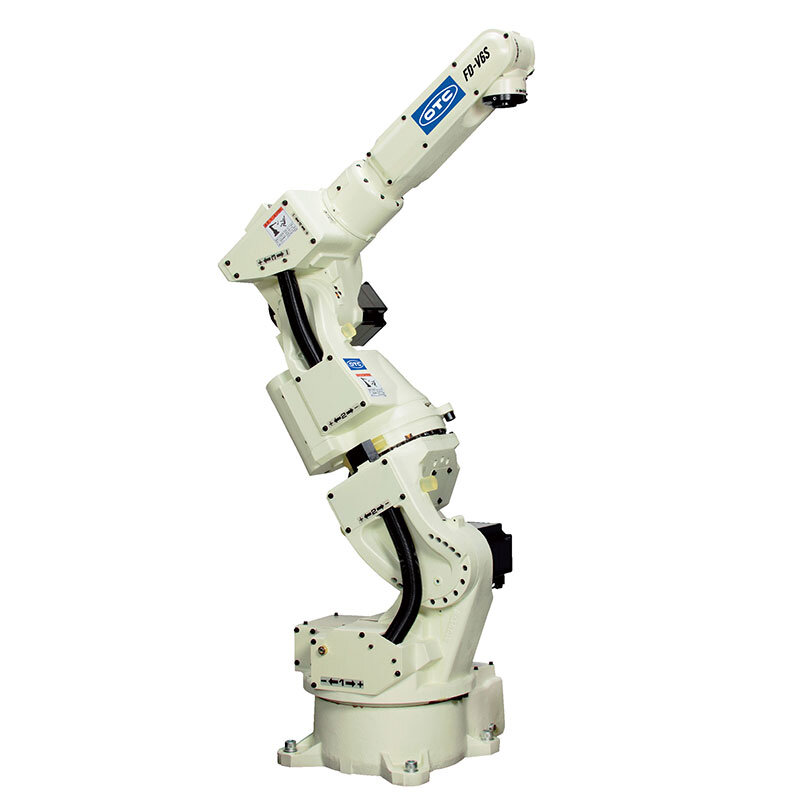
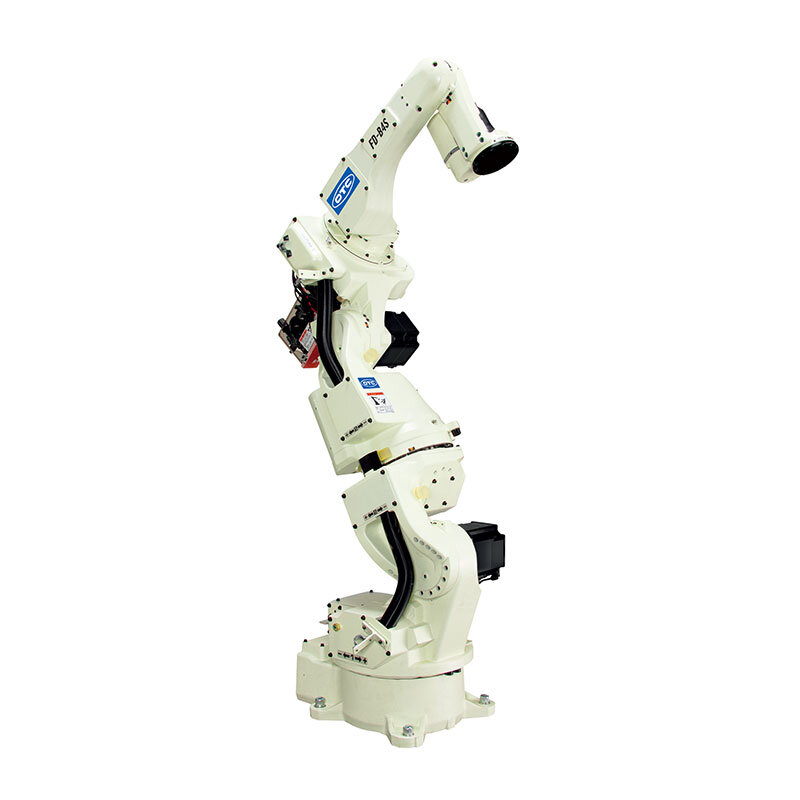
To break through this physical limit, OTC DAIHEN innovatively launched industrial-grade 7-axis welding robots (such as the FD-V6S and FD-B4S series). By adding a highly flexible additional rotation axis (the 7th axis) to the lower arm or wrist of the robotic arm, the robot can freely “twist” its arm to bypass obstacles while maintaining the TCP (Tool Center Point) and welding torch posture absolutely stationary. This redundant degree of freedom design brings six subversive core advantages to the manufacturing of complex components:
Figure 1: OTC Daihen 7-Axis Welding Robot FD-V6S Highly Flexible Anti-Interference Operation Model
Perfectly Evade Tooling Interference, Ultimate Reachability in Narrow Spaces
The greatest value of a 7-axis robot lies in its “obstacle avoidance” capability. In complex fixtures densely packed with clamping cylinders and positioning pins, or when reaching deep into a box for welding, the 7-axis robot can leverage its redundant joint degrees of freedom to easily bend the robotic arm “elbow” to bypass obstacles. This not only significantly lowers the design requirements for tooling fixture clearance space but also allows effortless completion of complex geometric weld seams, such as pipe-to-pipe intersecting lines and inner cavity dead corners, which are completely unreachable by traditional 6-axis robots.
Maintain Extremely High Welding Torch Posture Consistency, Enhancing Welding Quality
When performing continuous circular seam welding around complex cylindrical parts or polyhedrons, traditional 6-axis robots frequently encounter joint singular points, forcing them to interrupt arc ignition, terminate the arc, and drastically re-adjust the robotic arm’s posture mid-way. However, the 7-axis robot can digest spatial motion displacement through the twisting of the arm itself without altering the optimal welding tilt angle of the torch (TCP posture lock), thereby achieving a perfect continuous weld from start to finish in one pass, vastly improving the consistency and tensile strength of the weld ripples.
Fully Built-In Hollow Routing Design, Completely Eliminating Cable Interference
7-axis models like the OTC FD-V6S / B4S extensively utilize cutting-edge full-hollow built-in cable designs. The main power shielded cable, flexible wire feeding conduit, and shielding gas tube of the welding machine all penetrate from within the robot base and extend all the way to the sixth axis flange plate. This design completely eliminates the risk of physical snagging and abrasive wire breakage between external mounted harnesses and workpieces or surrounding fixtures during high-speed rotation, allowing the robot to work unimpeded in extremely tight and compact tunnels or cavities.
Effectively Replace and Eliminate the Need for Expensive External Positioners
In certain scenarios involving multi-faceted flip welding, it used to be necessary to invest huge funds in external horizontal rotary tables or dual-axis tilt positioners to position the weld seam ideally. Relying on its super-large-range joint twisting capability, the 7-axis robot is equivalent to having a “built-in” virtual positioning function on the robot body. Without any external tooling flipping, merely leveraging the extremely high flexibility of the manipulator, it can achieve overhead/fillet welding transitions on the back or side-bottom, substantially saving equipment acquisition costs.
Drastically Save Workshop Floor Space, Optimizing Production Line Layout
Because the 7-axis robot can execute “self-folding” and obstacle avoidance movements within extremely tight, limiting spaces right next to workbenches or safety fences, it completely eliminates the need for surplus clearance buffer zones. This means enterprises can arrange higher-density, more compact automated multi-station welding assembly lines within the same plant footprint, freeing up highly valuable floor space for new product capacity expansion.
Lower Ancillary Equipment Investment and Long-Term Comprehensive Maintenance Costs
By reducing reliance on complex flip tooling, large external positioners, and long-span external wire harness cable trays, the 7-axis robot system drastically streamlines the electromechanical integration complexity of the entire workstation. Fewer motion nodes not only signify a reduction in initial hardware procurement investment, but also imply that over the lengthy service cycle ahead, the enterprise’s comprehensive downtime and maintenance expenses arising from equipment wear, wire breakage, and external axis lubrication will drop off a cliff.
Figure 2: OTC Daihen 7-Axis Narrow Space Deep Penetration Welding Robot FD-B4S Model
Core Technical Tips for 7-Axis Robot Integration Selection and Teach Programming:
- Advanced Redundant Parameter (E-Axis) Control for 7-Axis Programming: When using the teach pendant for trajectory programming of the OTC 7-axis robot, in addition to regular X/Y/Z and posture parameters, operators must pay special attention to the parameter settings of the redundant axis (E-axis / elbow angle). When interference alarms occur, special combination keys on the teach pendant must be used to independently rotate the 7th axis (elbow), raising or dodging the arm while the TCP remains stationary, then saving that specific redundant posture. This imposes higher professional demands on the 3D spatial logic of programmers.
- Periodic High-Precision Axis Cross Maintenance: Compared to 6-axis models, a 7-axis robot has an extra high-precision RV/harmonic reducer transmission axis. This redundant axis withstands complex dynamic torque during high-speed flips for obstacle avoidance. The workshop equipment department must strictly adhere to the official rigid 10,000-hour maintenance cycle, executing synchronous extraction and replacement of the original special reducer grease
VIGOGREASE RE0orSK-2for the added joint axis, safeguarding the entire machine’s stringent ±0.05mm repeat positioning accuracy from early degradation.
️ Get Customized Automation Solutions, Real-Time Quotes, and Whole-Machine Tech Support for 7-Axis Robots
The OTC Daihen 7-axis highly flexible welding robot can help your complex component production line cross physical bottlenecks, boosting production efficiency and weld consistency to entirely new levels. To match you with the optimal machine model (like V6S or B4S arm span specs) and digital welding power source, please inform our technical directors of your workpiece outer dimensions, materials, and interference pain points. We will issue detailed workstation configuration lists and official standard quotes for you free of charge; meanwhile, providing fast spot direct supply for original control boards, servo motors, reducers, and preventative maintenance consumables: