



In TIG Welding (Gas Tungsten Arc Welding) operations, many welders tend to focus entirely on welding current and tungsten electrode grinding, often overlooking a highly underestimated consumable: the TIG welding ceramic nozzle (alumina cup). The primary function of the ceramic nozzle is to gather and direct the argon gas, forming a strict inert gas shielding envelope around the molten pool. The type, inner diameter, and internal structure of the ceramic nozzle directly determine whether the shielding gas flow is laminar or turbulent, which in turn decisively impacts the weld bead profile, weld seam color, and the occurrence of welding defects.
1. Three Major Types of TIG Ceramic Nozzles & Application Scenarios
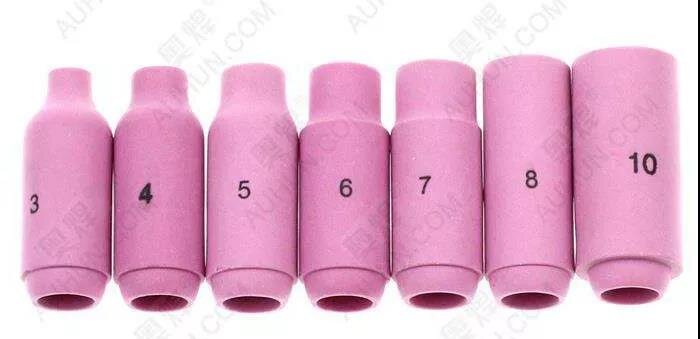
Based on their structure and neck design, the common TIG welding torch ceramic nozzles on the market are mainly divided into the following three categories:
- 1. Standard (Straight) Ceramic Nozzles: The most basic and conventional model. These nozzles have fewer gas diversion holes, offering average gas compression and focusing capabilities, and weak resistance to crosswinds. They are most commonly used in standard indoor welding conditions where the tungsten electrode stick-out does not exceed 5mm.
- 2. Long-Neck (Flared/Bell-Shaped) Ceramic Nozzles: Characterized by a gentle converging and diverging internal structure (similar to a bell mouth). This design effectively compresses the gas flow, increases the exit velocity, stabilizes the gas column, and significantly enhances wind resistance. They allow a tungsten stick-out of 5~8mm, making them highly suitable for outdoor use or environments with mild convective drafts.
- 3. Extra-Long (Deep Groove) Ceramic Nozzles: Specifically designed for narrow gap welding and root pass welding in thick-walled deep pipe grooves. These ultra-slender nozzles allow for an exceptionally long tungsten stick-out. Even when reaching the bottom of a deep groove, they ensure the gas does not create turbulence in confined spaces, thereby achieving an excellent root bead profile.
Technical Upgrade: In addition to the above types, high-end welding processes often utilize Gas Lens Ceramic Nozzles (with mesh filters). Through multiple layers of internal stainless steel mesh screens, the gas flow is completely transformed into a perfect “laminar flow” state, providing a wider and extremely uniform gas shielding coverage.
2. Core Selection Principles: Matching Nozzle Models with Welding Processes
To achieve a visually appealing, perfectly rippled weld bead with brilliant colors (especially on stainless steel), the selection of ceramic nozzles must adhere to the following 4 core technical principles:
- Select based on the chemical activity of the base metal: Carbon steel and standard low-alloy steels have standard gas shielding requirements. However, highly active metals like titanium alloys, aluminum alloys, magnesium alloys, and stainless steel are extremely prone to oxidation at high temperatures. You must choose a ceramic nozzle that is 1 to 2 sizes larger than usual, and ideally pair it with a gas lens (mesh filter) to ensure the high-temperature zone is fully blanketed by argon.
- Match with the tungsten electrode diameter: The nozzle size is generally positively correlated with the tungsten diameter. If a thin tungsten electrode (e.g., 1.6mm) is paired with an oversized nozzle, the gas flow velocity will be too slow, resulting in weak shielding. If a thick tungsten electrode (e.g., 3.2mm or above) is paired with a small nozzle, the gas flow is severely obstructed, which can easily burn the electrode and cause tungsten inclusion defects.
- Adjust according to the welding current: Higher welding current generates a hotter arc column, expanding the molten pool area and the surrounding heat-affected zone. Therefore, use small nozzles for low currents and large nozzles for high currents. If the nozzle is too small during high-current welding, the shielding gas will rapidly expand and degrade, losing its protective effect.
- Adjust based on the welding phase (Root / Fill / Cap pass):
- Root Pass & Fill Pass: To allow the welding torch to penetrate deep into narrow grooves while maintaining a clear view of the molten pool, small-bore ceramic nozzles (#6 or smaller) should be selected.
- Cap Pass (Cover Pass): Especially when capping stainless steel pipes or plates, to achieve that brilliant silver-white or golden aesthetic finish, you must switch to large-bore ceramic nozzles (#12 or larger) for extensive temperature-control shielding.
3. Welding Expert Summary: Ceramic Nozzle Selection Quick Reference
To assist front-line welding workshops and process engineers in quick and scientific matching, please refer to the following standardized selection guide:
| Welding Phase / Condition | Recommended Nozzle Size | Applicable Tungsten Dia. | Applicable Base Metal | Gas Flow Requirement |
|---|---|---|---|---|
| Deep Groove Root Pass | #4 – #6 (Small Bore/Extra-Long) | 1.6 – 2.0 mm | Carbon Steel / Low-Alloy / Stainless Steel Root | Focused Narrow Jet |
| Med/Heavy Plate Multi-Pass Fill | #7 – #10 (Standard Type) | 2.4 – 3.2 mm | General Metals & Conditions | Standard Conical Shielding Flow |
| Stainless/Alloy Steel Cap Pass | #12 – #16 (Large Bore Wide Shield) | 2.4 – 3.2 mm | Stainless Steel / Aluminum / Copper Alloys | Large Area Laminar Diffusion Shield |
| Titanium/Magnesium (High Activity) | Jumbo Size (with Multi-layer SS Mesh) | 2.4 – 4.0 mm | Titanium Alloys / Aerospace Magnesium | Ultra-Pure Absolute Laminar Gas Curtain |