



OTC Daihen RT3500H Series Welding Torch Core Structure and Accessories Analysis
In the OTC DAIHEN industrial welding robot system, the RT3500H series (including RT3500S, RT3500H, and RT3500L, three models with different torch neck lengths) is the most classic and widely used standard air-cooled CO₂/MAG automatic welding torch. It features excellent anti-collision rigidity and superior gas shielding laminar flow design.
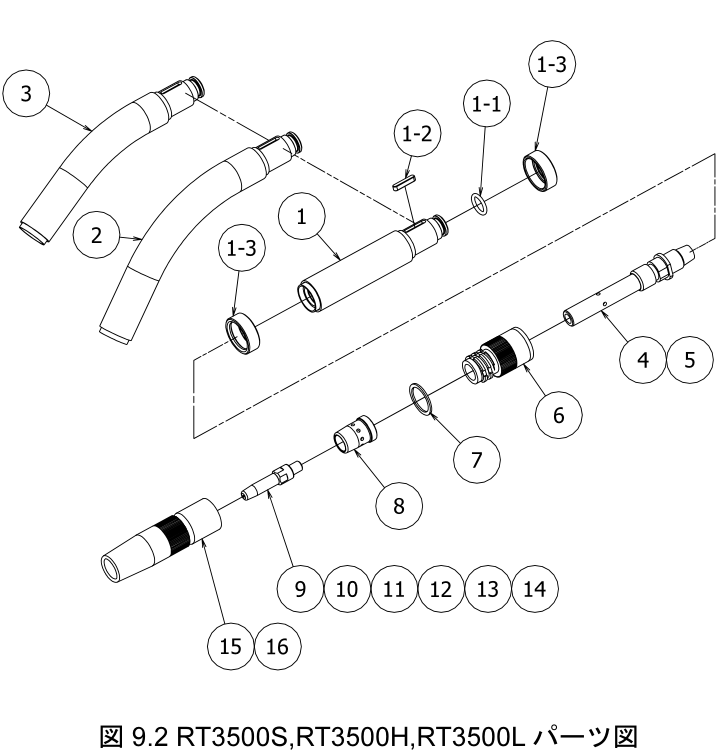
The welding torch operates long-term in the extreme high-temperature and spatter environment closest to the weld pool. Its internal gas diffusers, insulating sleeves, contact tips, and sealing O-rings are all high-frequency consumable parts. If inferior aftermarket parts are used or assembled incorrectly during daily maintenance, it can easily cause arc blow, dense weld porosity, or body leakage short circuits. When overhauling the welding torch or replacing consumables, please strictly refer to the official original exploded view and parts model list below:
Figure 1: OTC Daihen RT3500H/S/L Series Welding Torch Internal Structure Original Exploded View
2. Detailed Model Comparison Table of Original Parts for RT3500H Series Welding Torch
Please carefully verify the corresponding digital sequence numbers (1 to 16) in the exploded view above. This data table adopts a high-definition solid line and alternating zebra stripe design, with a rigorous structure, ensuring maintenance personnel can precisely query and procure the required insulating parts and copper consumables:
| Image No. | Official Order Model | Standard Accessory Name | Function Remarks and Maintenance Instructions |
|---|---|---|---|
| 1 | L10603B00 | Torch Body | Main torch body section connecting the robot’s coaxial cable. |
| 1-1 | 3574-017 | O-Ring | Core sealing rubber ring at the torch body interface to prevent shielding gas leakage. |
| 1-2 | 100-1238 | Set Screw | Anti-loosening hardware for fixing the torch body assembly. |
| 1-3 | L10603B04 | Cushion | Shock absorption and mechanical cushioning washer for the torch body. |
| 2 | L10605B00 | Swan Neck | Front-end tube neck of the welding torch with a fixed bending angle (determines TCP coordinates). |
| 3 | L10604B00 | Welding Torch Body | Transitional metal part connecting the swan neck and the main torch body. |
| 4 | L10603C01 | Contact Tip Base | Copper base that fixes the contact tip and transmits strong welding power. |
| 5 | L10603E01 | Insulating Spacer | Insulating accessory that blocks potential conduction. |
| 6 | L10603D00 | Insulator | Core high-temperature insulating sleeve to prevent the torch shell from being electrified and breaking down. |
| 7 | L6380F01 | Spring | Fixing spring used to clamp the outer nozzle. |
| 8 | U4167G02 | Gas Diffuser | Evenly disperses CO₂/Ar shielding gas to form a stable gas shield. |
| 9 | L7250B04 | Contact Tip | Core high-frequency easily worn copper consumable (selected according to actual wire diameter). |
| 10 | L7250B01 | Contact Tip | Alternative specification contact tip. |
| 11 | L7250B02 | Contact Tip | Alternative specification contact tip. |
| 12 | L7250B03 | Contact Tip | Alternative specification contact tip. |
| 13 | L7250B05 | Contact Tip | Alternative specification contact tip. |
| 14 | L7250B06 | Contact Tip | Alternative specification contact tip. |
| 15 | L10603C02 | Nozzle | Standard diameter outer anti-spatter copper protective nozzle. |
| 16 | L10603C03 | Nozzle | Alternative specification nozzle. |
Core Warnings for RT3500H Torch Workshop On-Site Maintenance and Error Prevention:
- Beware of Porosity Disasters Caused by Aging 3574-017 O-Rings: The O-ring seals inside the welding torch not only withstand high-frequency mechanical vibration but are also directly exposed to high-temperature environments. Once this rubber ring hardens and cracks, the shielding gas originally intended for the weld pool will leak inside the torch body prematurely. This causes the airflow at the nozzle to be abnormally weak, failing to effectively displace the air, ultimately generating dense honeycomb porosity (nitrogen/oxygen intrusion) inside the weld seam. Mandatory replacement of O-rings is required during overhauls.
- Prevention of High-Voltage Breakdown and Carbon Deposition of the Insulator (L10603D00): The insulator is responsible for isolating the strong welding power on the contact tip base from the externally grounded torch neck. Under heavy spatter conditions, the insulator’s surface is highly prone to accumulating black carbonized sludge and fine metal particles. If the nozzle is not regularly removed for thorough cleaning, these conductive residues will form a “creepage bridge,” causing the outer nozzle or swan neck to carry high arc voltage. This not only easily burns out the robot’s anti-collision sensor but also poses a severe risk of electric shock to personnel.
- TCP Deviation After the Swan Neck (L10605B00) is Hit: The swan neck is the absolute physical benchmark determining the robot’s TCP (Tool Center Point) accuracy. Although the RT3500H is extremely rigid, if a severe collision occurs, the swan neck will still undergo slight bending that is hard to detect with the naked eye. Once bent, all previously taught welding trajectories will deviate. Do not use a hammer to violently strike and correct it, otherwise it will damage the inner tube. A brand-new original swan neck must be replaced, and the TCP calibration procedure must be re-executed.
️ Quick Access to RT3500H Series Robot Torch Consumables In-Stock Quotes & Technical Support
The wear resistance of the copper contact tip and the airtightness of the gas diffuser directly determine the yield rate of automated continuous welding. Whether you need bulk procurement of daily consumable L7250B series contact tips and L10603C02 nozzles, or need to completely refurbish and replace the L10605B00 swan neck assembly and full set of insulating parts, welcome to provide your part sequence number. Contact us directly for the latest official standard ex-factory quotes and today’s direct shipping service: